
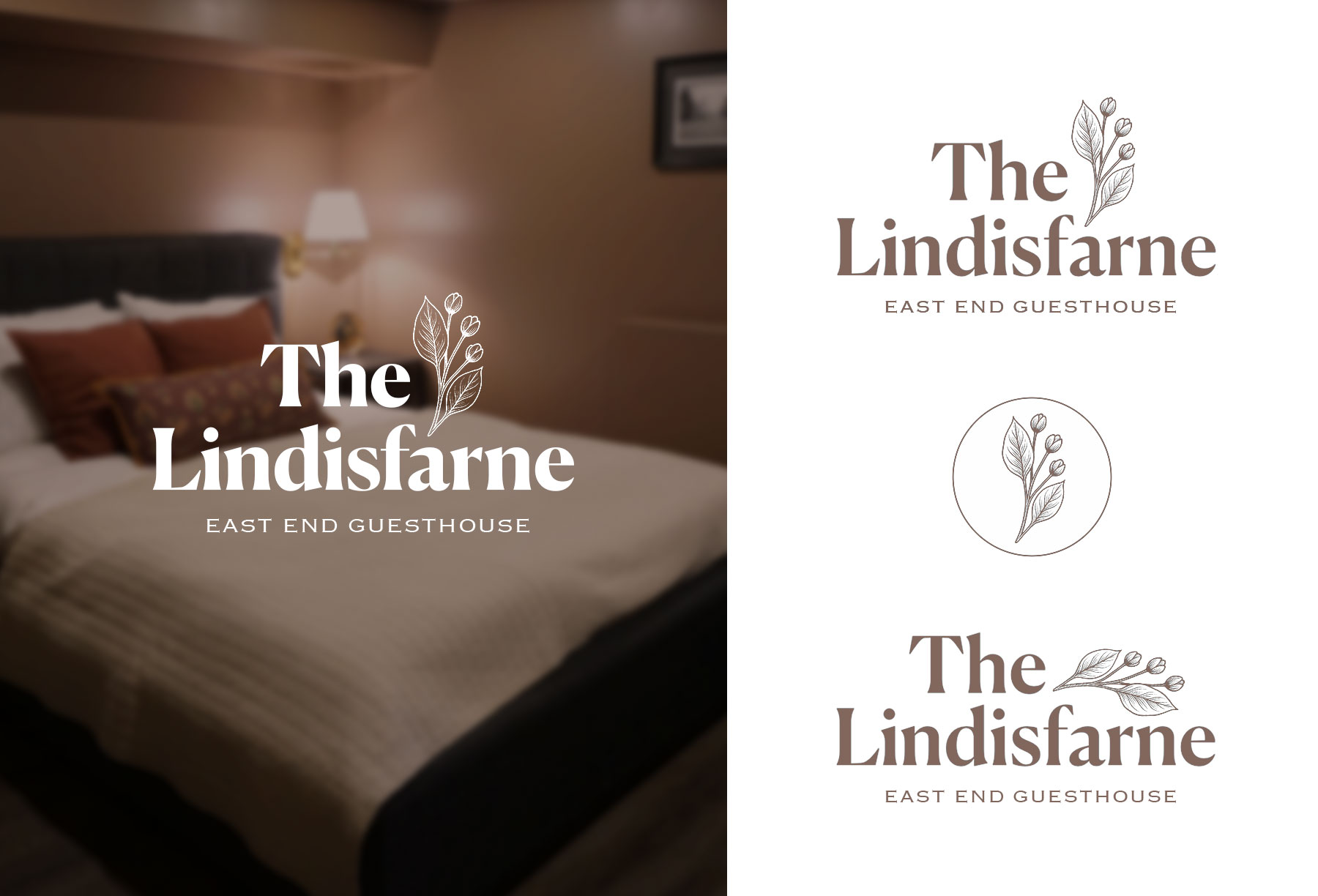
The Lindisfarne
AI-Powered Storytelling.Creating a Character-Driven Guest Experience for a Heritage Guesthouse
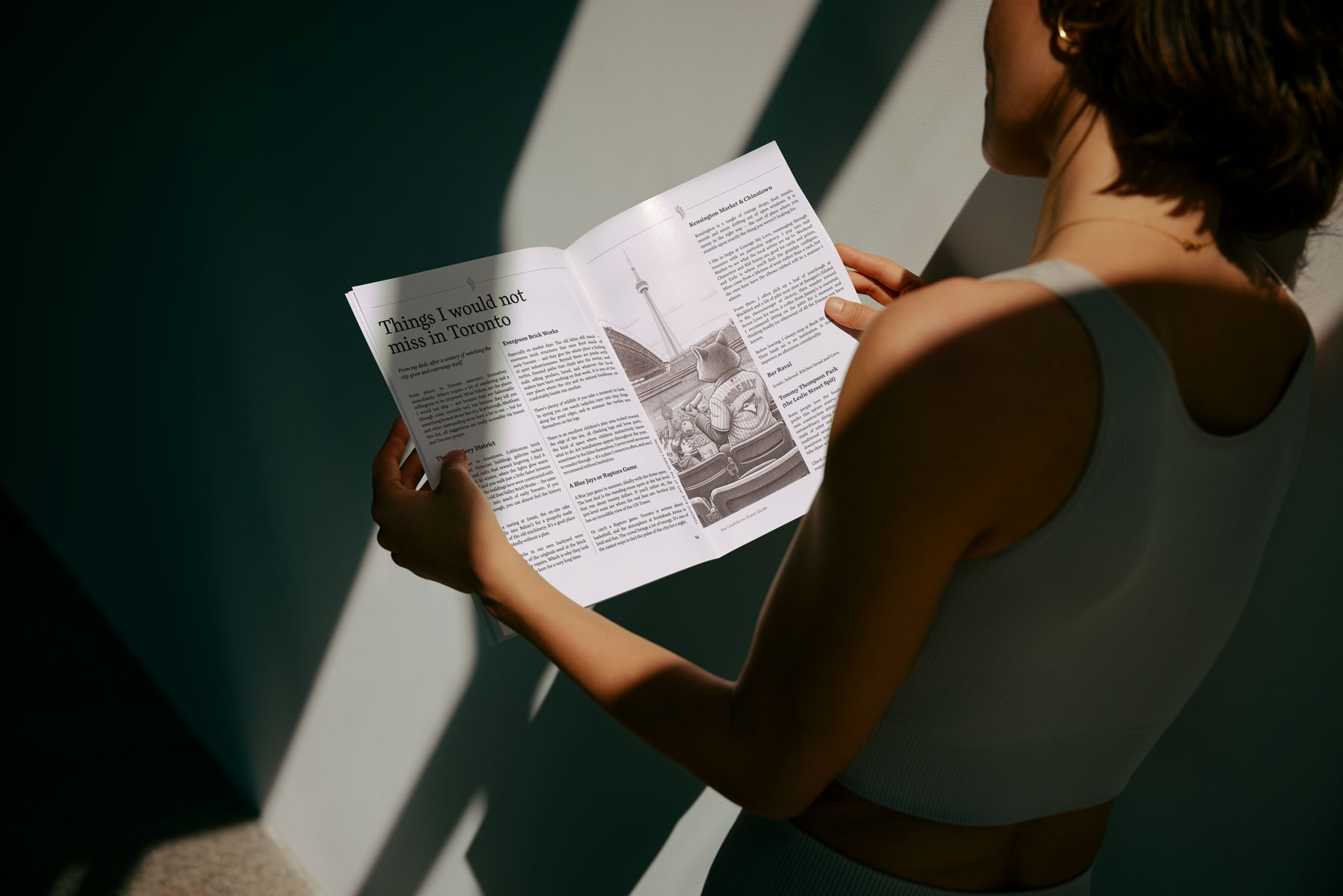
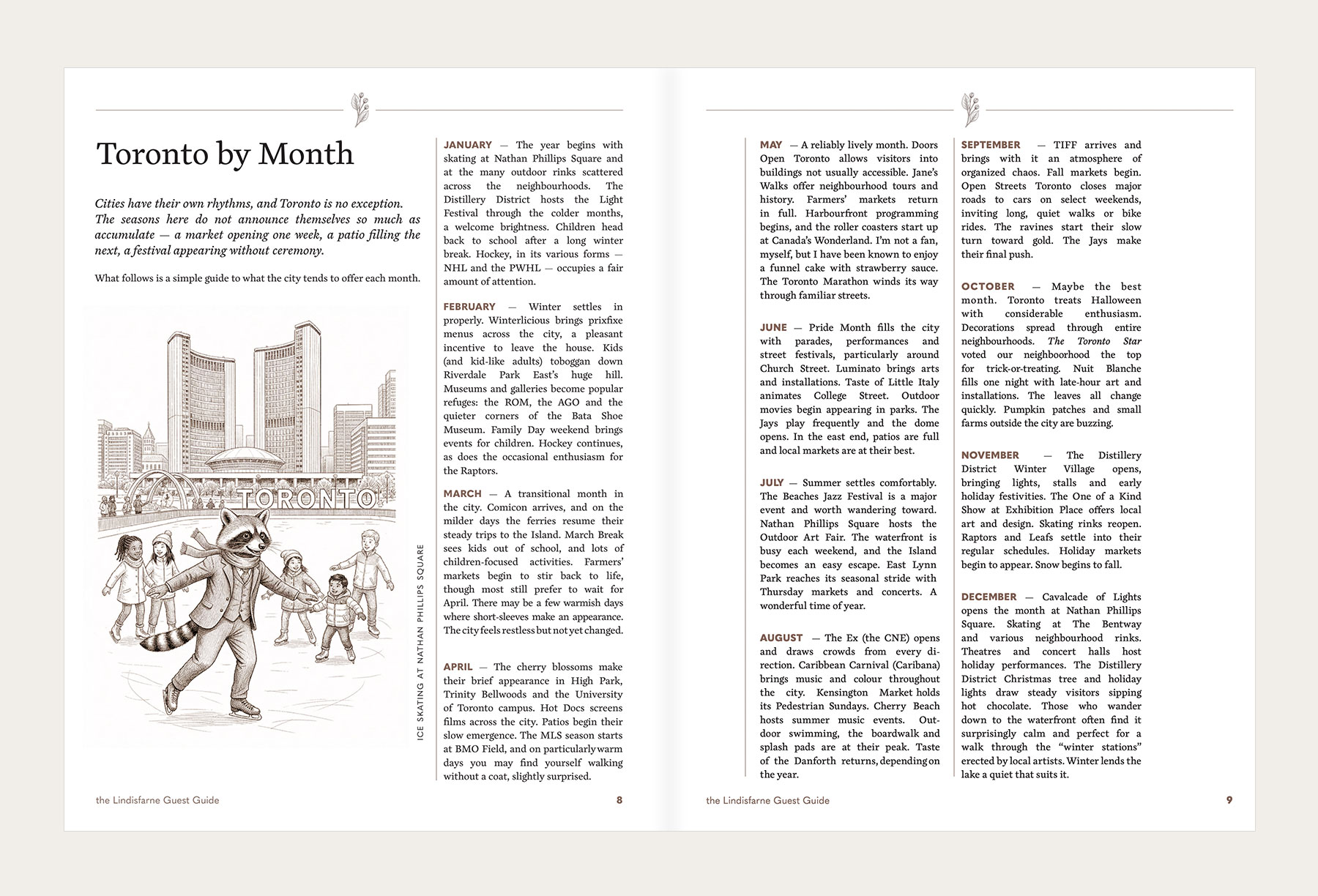
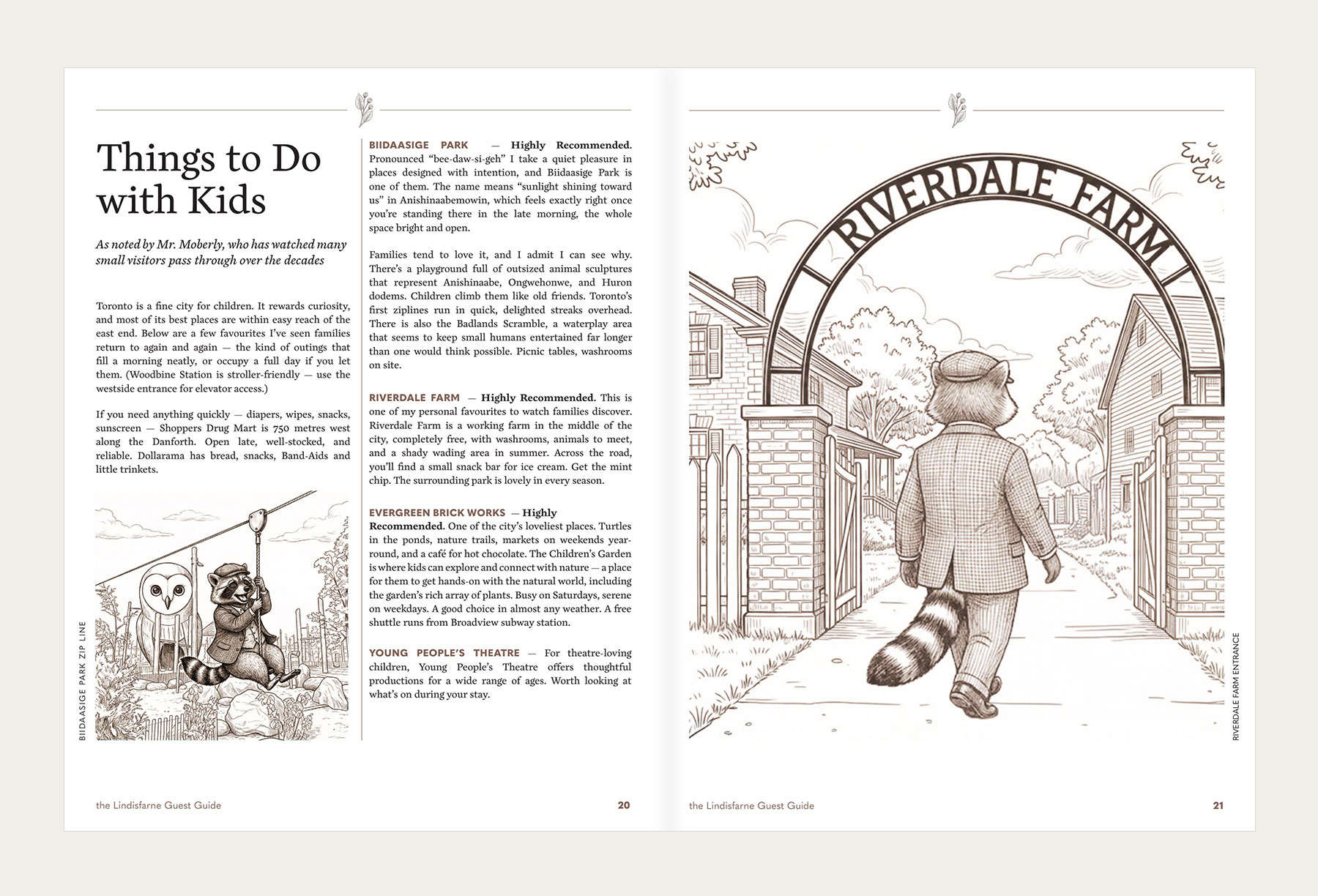
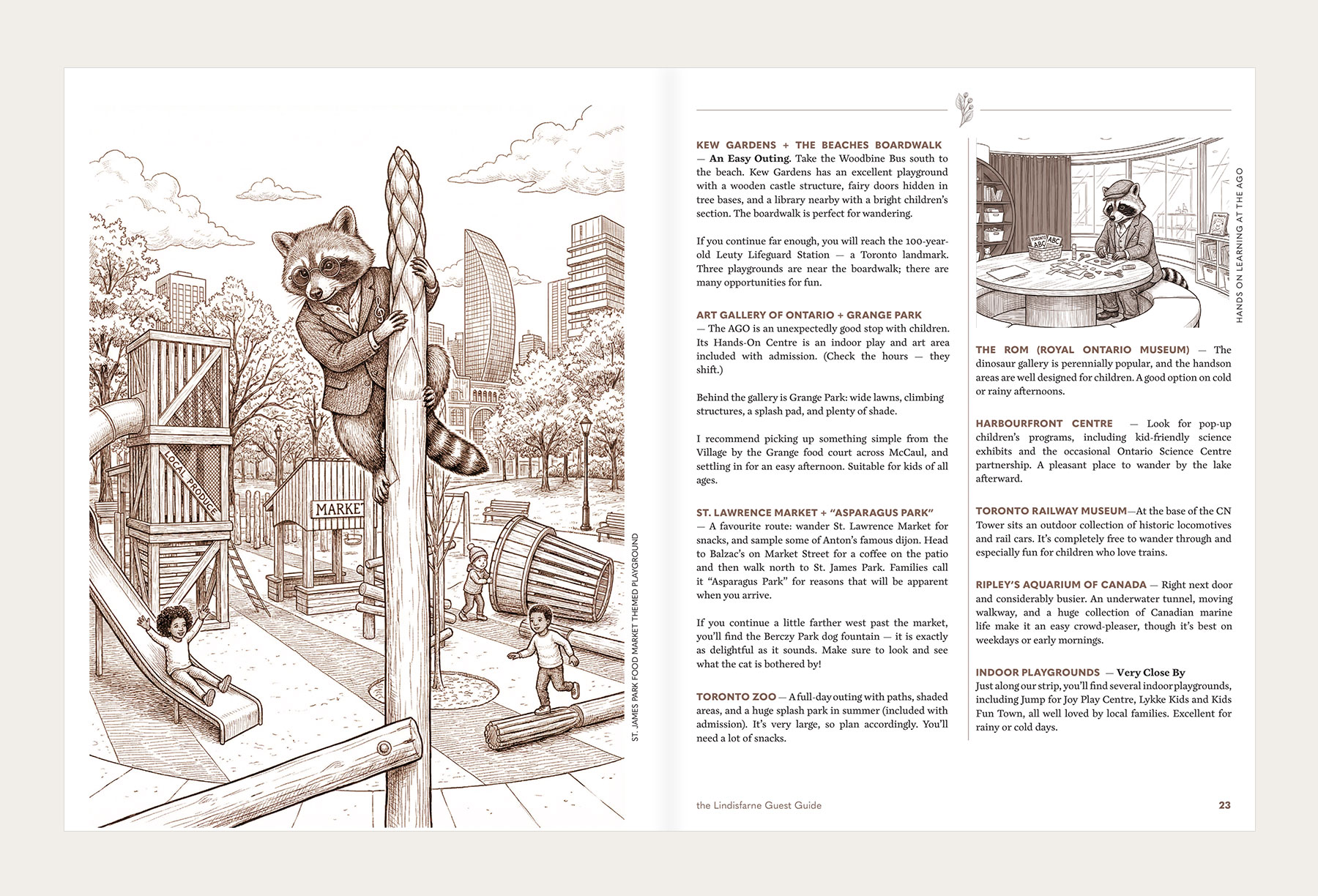
The Lindisfarne is a boutique Airbnb in Toronto’s east end, housed in a designated Century Home with deep musical roots — the former residence of Simon Cowe, founding member of British folk-rock band Lindisfarne. I transformed an empty lower-level apartment into a character-driven guest experience anchored by Mr. Moberly: an AI-generated raccoon who serves as host, narrator, and resident charmer. (Toronto’s raccoons are a civic institution — bold, unbothered, and completely at home wherever they please.) Mr. Moberly appears throughout the physical space, narrates a 30-page guest book, and inhabits 20+ custom illustrations, each consistent in style, character, and voice.
Roles
Creative Director, Brand Strategist, AI Art Director, Designer, Copywriter, Prompt Engineer
Methods
Heritage Research, AI Character Development, ChatGPT-4o, Gemini, Midjourney, Prompt Engineering for Visual Consistency, Brand Voice Design, Spatial Storytelling
Results at a Glance
- Launched January 2026 with 5-star reviews highlighting the “unique character” and “thoughtful storytelling”
- Achieved character consistency across 20+ AI-generated scenes — one of the hardest unsolved problems in generative AI
- Delivered complete brand (research, character design, copywriting, interior design, visual identity) in 3 months
- Built narrative-first guest experience that proves that narrative is a hospitality strategy, not just decoration
- Created a replicable AI-enhanced workflow for character-driven brand experiences
CHALLENGE
How might we create a distinctive, story-rich Airbnb experience that honours a home’s century of history while using AI to build a fully realized character, consistent and memorable at every turn?
The challenge was threefold: surface and honour the home’s layered history, create a cohesive brand experience across digital and physical space, and maintain a single fictional character with visual and narrative consistency across 20+ scenes, styles, and contexts.
Most AI creative work uses generative tools for one-off images — a poster, a hero visual, a mood board. The Lindisfarne required something far more demanding: a single fictional character, rendered consistently across 20+ distinct scenes, in a vintage sepia etching style, placed photorealistically into Toronto landmarks and domestic environments. The entire guest experience had to feel like stepping into his world. The character informing not just the story, but the finishings, the details, the atmosphere of the space itself.
Character drift — where AI gradually shifts a character’s features, proportions, and style across generations — is one of generative AI’s most persistent challenges. Solving it requires thoughtful prompting and building a visual language: reference anchors, style constraints, lighting rules, and iterative refinement that holds a character together across an entire production.
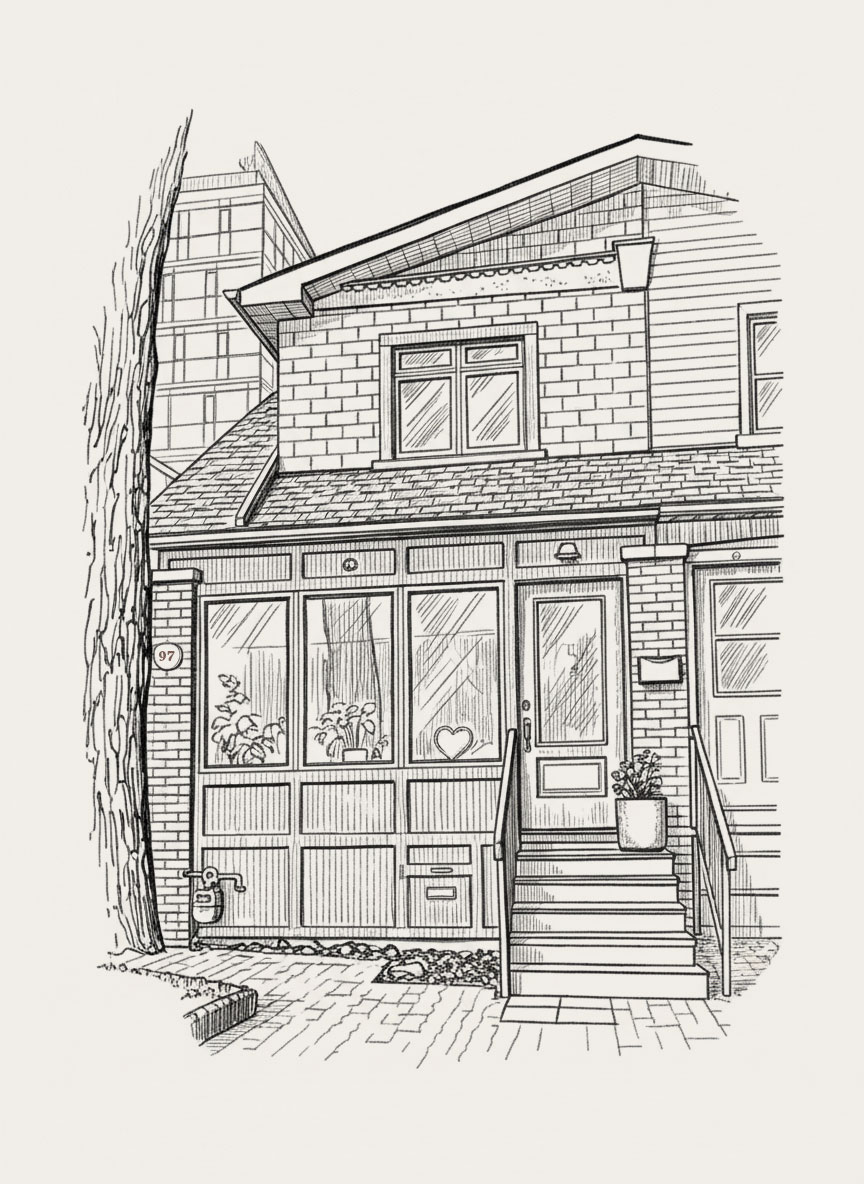
Deep heritage research into house history and neighborhood lore.
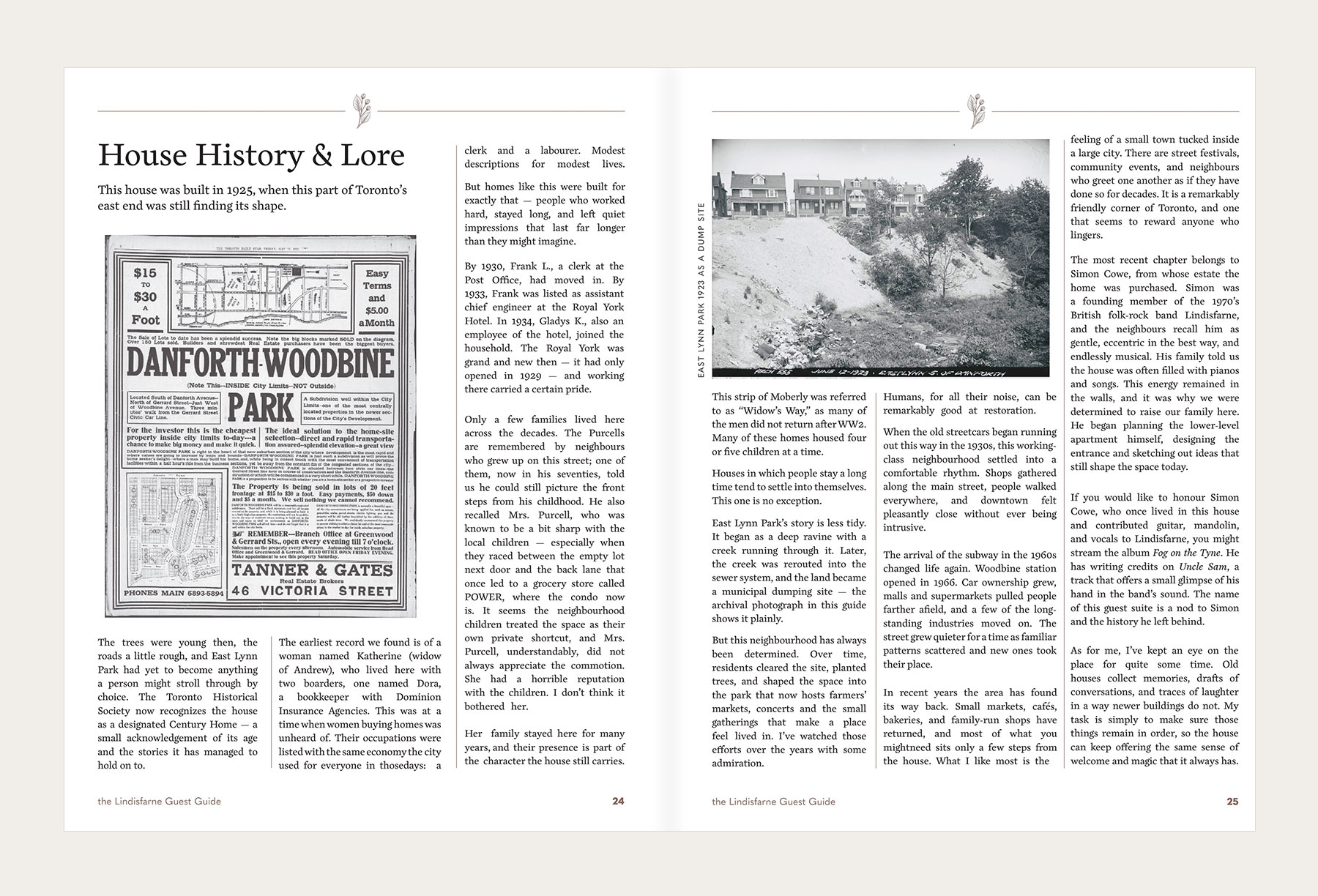
I began with deep heritage research: archival records, Toronto Historical Society documentation, and neighbourhood oral histories. This uncovered Katherine, a widow who owned property in the 1920s when women rarely did; families who stayed for decades; the “Widow’s Way” nickname for the street after WWII; and Simon Cowe’s musical legacy. The research became the foundation for everything that followed, and found its way into every page of the guest book.
This discovery ultimately led to the home being designated a Century Home by the City of Toronto, marked with a custom ceramic Century House plaque.
Creating the Resident Host
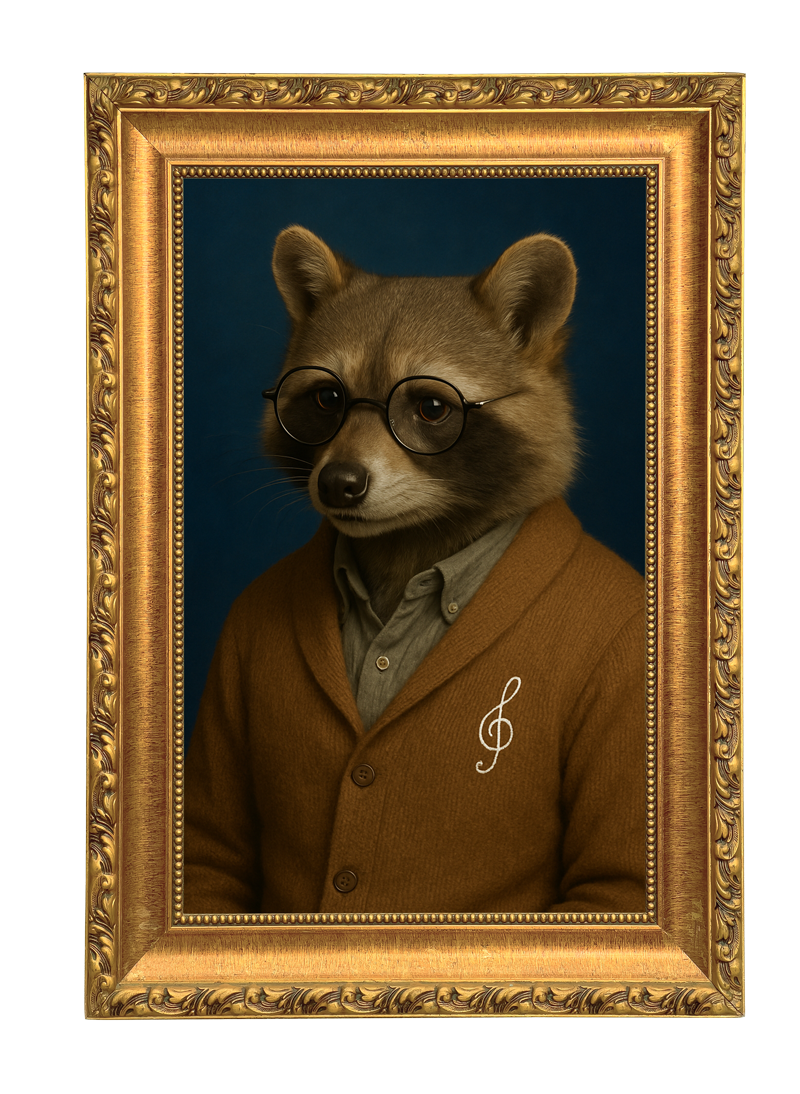
Mr. Moberly hosts you. A quiet charmer. The sort of raccoon who leaves handwritten notes on linen paper. He makes blackcurrant jam in spring and spiced plum brandy in fall. He plays piano by ear, collects old newspaper advertisements, prefers craft beer from the can, and once opened for a folk trio in Yorkville in the ’60s, before they got big. He doesn’t brag.
His voice was deliberately constructed. Wistful. Dry. Slightly sardonic. First-person observations grounded in personal ritual and sensory detail. He speaks the way someone does when sharing a small secret, never a listicle.
You’ll find him tucked into the walls, the scent of plum lingering in the air, and maybe, just maybe, humming down the hall.
“I trust the house treated you kindly. It has good manners, most of the time. The neighbourhood has its rhythms. Coffee in the morning, dogs in the afternoon, the odd raccoon after midnight. If you heard someone bothering the piano, that was me. If you smelled plum, that was the brandy. – M”
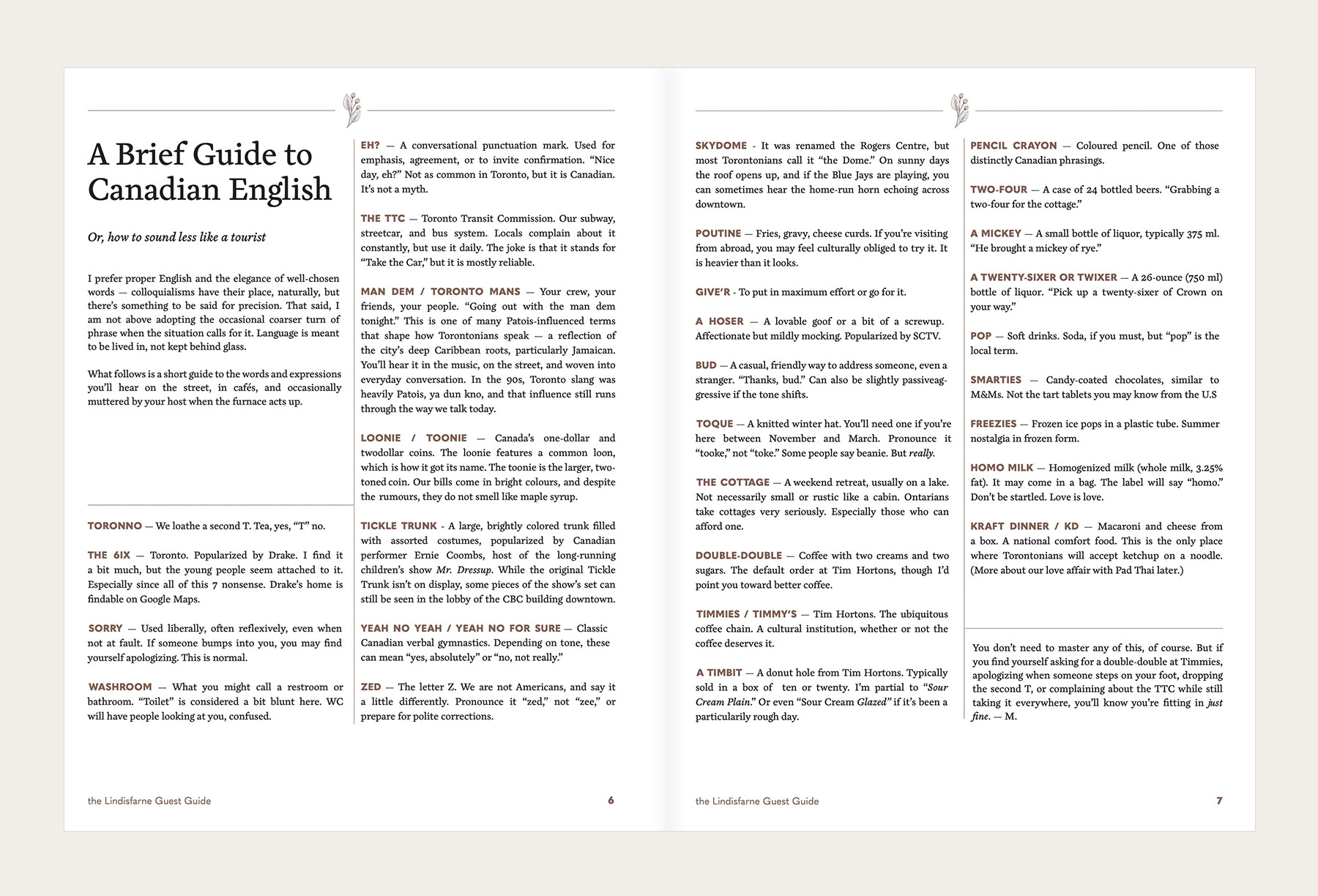
That voice governs the entire guest experience. The 30-page guest guide. The Airbnb listing. Welcome notes. Illustration captions. Even the WiFi password and the recycling instructions. Calm. Observant. A little smug, but only in ways he’s earned. He recommends what he genuinely likes, not what he’s supposed to.
AI character design to build narrative cohesion across the physical guest experience.
Mr. Moberly was built as a narrative system the organizing principle for the entire guest experience. He narrates the 30-page guest book, appears in welcome notes, voices the Airbnb listing, and shows up visually throughout the space. The WiFi password is in his voice. So is the note about the recycling.
The hardest creative challenge was visual consistency. Using Midjourney, ChatGPT-4o, and Gemini (Nano Banana), I built a repeatable visual production system: a master character reference with locked proportions, fur markings, and costume details; a style grammar of vintage sepia etching, cross-hatching density, and paper texture; scene-specific prompt templates that preserved character while adapting context. The result: 20+ illustrations that read as the work of a single illustrator with a distinct hand.
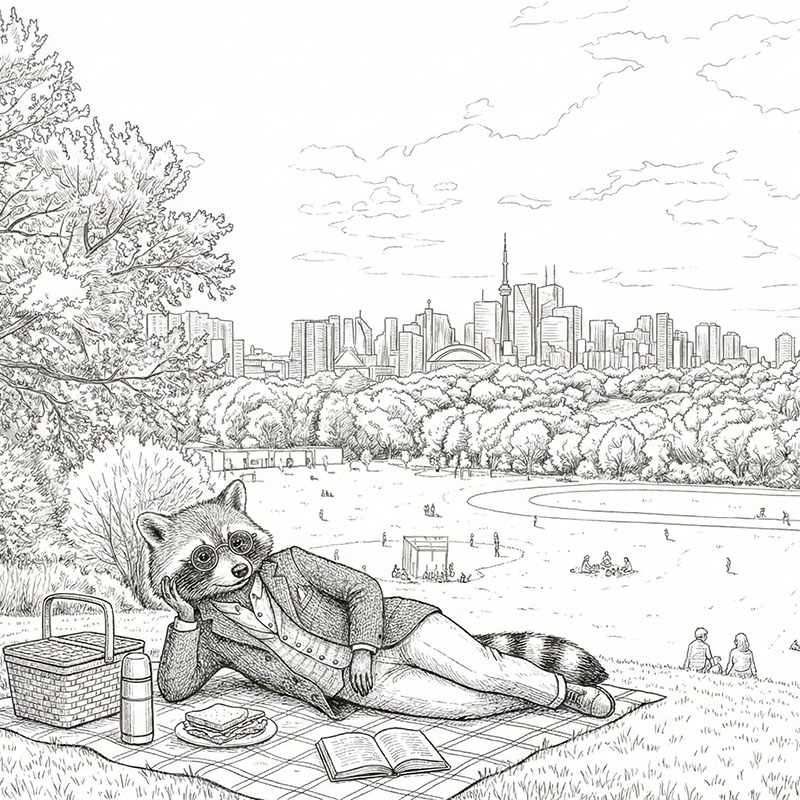
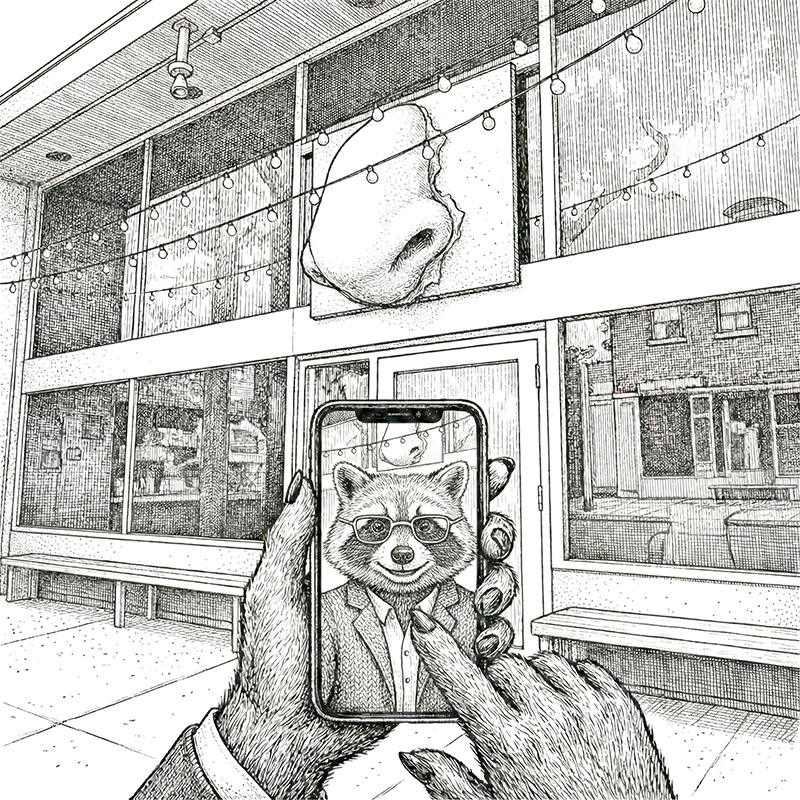
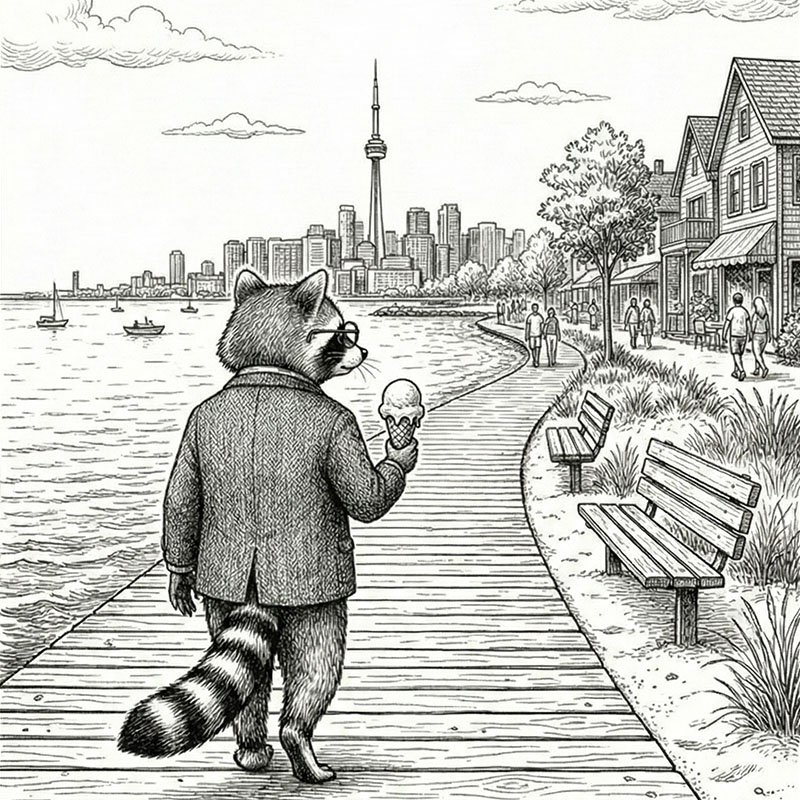
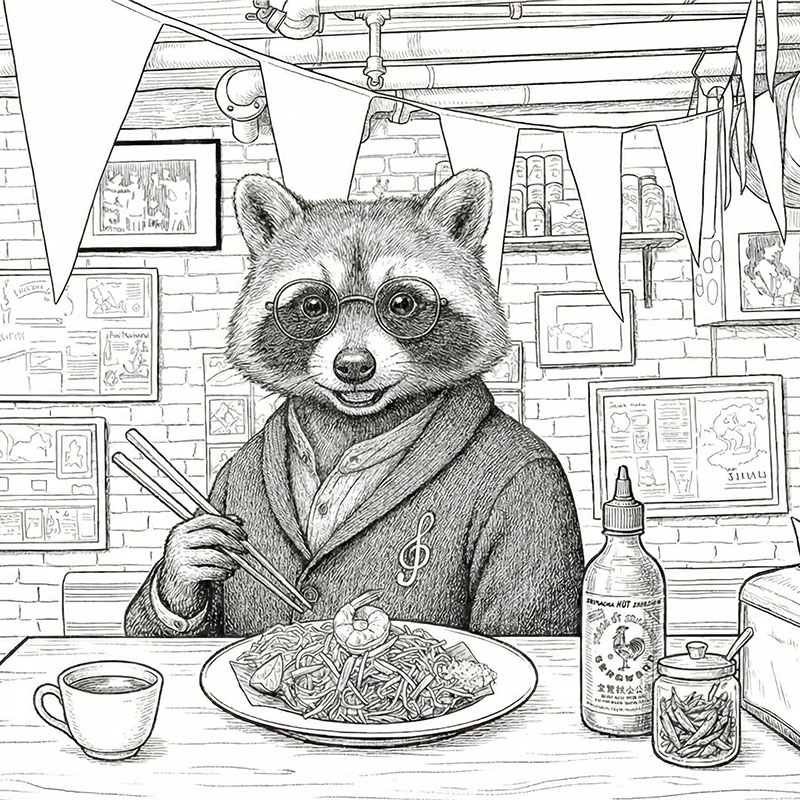
The Lindisfarne Guest Guide
Inside the Story
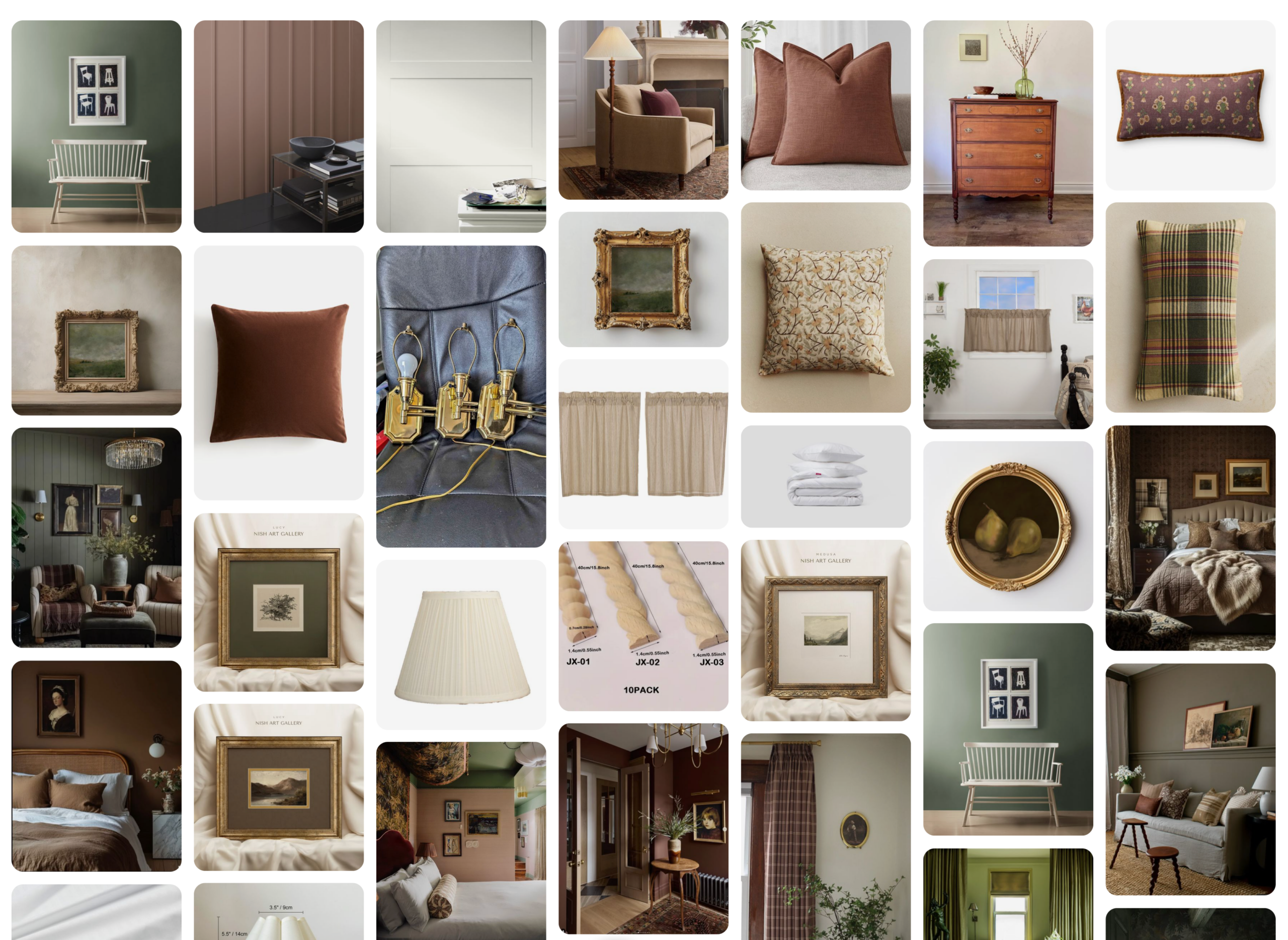
The physical space was designed to support the narrative: vintage-inspired interiors, rich colours, curated details, and finishings (each one a quiet nod to Mr. Moberly’s world) reinforce the story without overwhelming it.
At the same time, the space needed to meet the expectations of a modern Airbnb: light, airy, and immediately comfortable. The result is a careful balance. Crisp white linens and open, breathable layouts keep the space fresh, while thoughtful plaids, subtle florals, vintage print rugs, and brass details introduce warmth and character.
Materials quietly reference the surrounding neighbourhood. Heritage brick veneer echoes the red brick common across Toronto and the brickwork in the landscaped backyard. The living area is drenched in Benjamin Moore’s Riverbank, a deep reddish-brown that creates a moody, editorial centrepiece. A thin braided trim subtly stitches the sleeping area into its own nook. Even the pine-green bathroom and small details, including vintage brass sconces salvaged from the demolition of a historic Toronto hotel, velvet pillows, and a vintage Staffordshire Bull Terrier painting, contribute to a space that feels lived in rather than styled.
The result feels editorial, warm, and quietly storied.
What We Ended Up With
A complete brand identity and visual system, AI character design system with documented prompt engineering workflow. 20+ consistent AI-generated illustrations in vintage sepia etching style. 30-page narrative guest book covering history, neighbourhood guide, and house instructions — all in character voice. Interior design and physical space implementation. Airbnb listing copy, welcome materials, and brand voice guidelines. A replicable AI-enhanced workflow for character-driven brand experiences.
What Made This Work
The project demonstrates how AI tools can solve real creative direction problems when guided by strategy, research, and iteration. Most boutique accommodations rely on aesthetic alone. the Lindisfarne uses a central character to create narrative cohesion across every guest interaction. Character consistency across generative images remains one of the field’s toughest challenges. This project required solving it at production scale, resulting in a guest experience that feels handcrafted, historically grounded, and narratively cohesive (built almost entirely through AI-enhanced workflows).
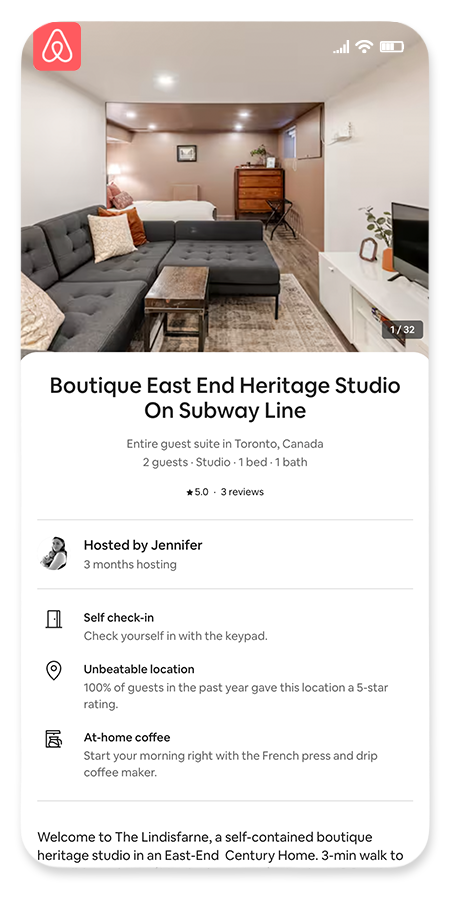
Visit the Airbnb listing at airbnb.ca/h/thelindisfarne
months research to listing
AI illustrations
page narrative guide book
star experience
Do you have creative problems that need solving?
Let’s connect.
Toronto, Canada | Say Hi! ⇢ jennifermyerschua@gmail.com | linkedin/JenniferMyersChua
© 2025 | 1000464603 Ont Inc and Jennifer Myers Chua. All rights reserved. All content on this website, including images, text, and designs, is the copyright of 1000464603 Ont Inc and its clients. No part of this website may be reproduced, downloaded, transmitted, or stored in any form or by any means, electronic or mechanical, without prior written permission from the copyright owner.